Supporting Tick Bites
Updated: Apr 9
This is NOT medical advice. Always work with your healthcare provider. This is simply what I would plan on doing as a bare minimum if we were to have a tick bite.
Knowing how to properly remove a tick, and support your body after a bite, can help lower the risk of infections like Lyme disease. Some of the herbal approaches mentioned here are inspired by protocols from Stephen Buhner, an herbalist known for his work in Lyme support.
While widely respected in holistic health, he was not a medical doctor, and these protocols are considered alternative (not part of standard medical guidelines). I find it helpful to keep options like these in mind while also working with a trusted healthcare provider.
STEP 1: Remove the tick using a TICK KEY
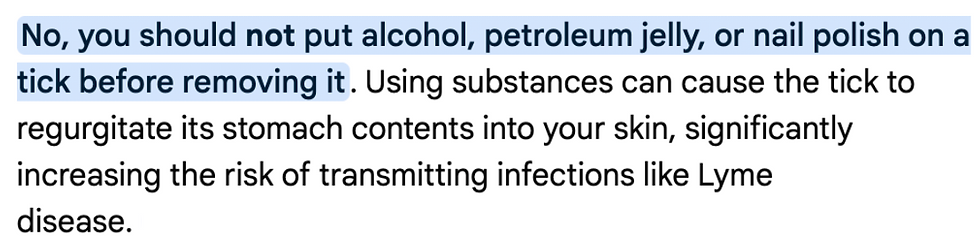
Do not apply anything to the tick before removal.

If you don’t have a tick removal tool, use fine-tipped tweezers to grasp the tick as close to the skin as possible, aiming for the mouthparts rather than the body. Pull upward with steady, even pressure. Avoid twisting or jerking, as this can cause parts of the tick to break off and remain in the skin.
STEP 2: Put tick in a baggy in the freezer
Place the tick in a sealed bag or container and store it in the freezer. To play it safe, the tick can be sent for testing (tickreport.com or tickcheck.com), but certainly if symptoms develop.
STEP 3: Thoroughly clean your hands and the bite area
Monitor closely and contact your healthcare provider if:
You’re unsure the tick was fully removed
It was deeply embedded
You notice worsening symptoms (increasing pain, swelling, or unusual reactions)
STEP 4: Topical clay support
Next create a paste with andrographis and green clay (if you don’t have green clay you could consider bentonite clay). Leave on for 24 hours.
STEP 5: Ledum Palustre
For bug bites that involve puncture wounds, Ledum palustre is often considered one of the most indicated homeopathic remedies. While opinions on dosing vary, homeopathy is based on energetic imprinting, so I personally view the number of pellets as less important than consistency. Here’s how I typically approach dosing:
Intense Symptoms: like high fever, ear pain, significant injuries, or more serious burns, frequent dosing is ideal. Dose every 5-30 minutes.
For Serious Symptoms: that bring clear discomfort, like headaches, vomiting, colds, or coughs. Dose every 1-2 hours.
For Moderate Symptoms: that cause minimal discomfort like a minor, sore throat. Dose every 4-8 hours.
For Mild Conditions: like exhaustion. Dose 1-3x/daily.
STEP 5: Astragalus
Next, Stephen Buhner recommends Astragalus. His adult dosing is 3,000mg for 30 days, then 1,000mg ongoing for as long as desired for prevention. For kids, I would personally do (1/8th) ~375mg for 30 days, ~125mg ongoing. If they handled that well I may move up to (1/4th) ~750mg 30 days; 250mg ongoing. For older kids (1/2th), 1,500mg 30 days; 500mg ongoing.
*Not recommended for active or chronic lyme
**For children especially, start low and go slow, monitor closely, and work alongside a trusted healthcare provider.
Tick Bite Red Flags
Bull’s-eye rash (erythema migrans)
Flu-like symptoms
Fever
Facial palsy (Bell’s palsy) or asymmetrical joint pain/swelling
Swollen lymph nodes
Red, expanding or streaking rash
Changes in mood, behavior, appetite, or coordination
Severe headache / neck ache

Comments