I'm a Crunchy Mom, and I'm Using Fluoride
Updated: Jun 6
I know the holistic side of the internet is full of "fluoride = bad" talk. I'm a crunchy-ish mom who has worked in the holistic, airway dentistry field for over 10 years and cares deeply about lower-tox living, and yet…during my son’s expansion journey, I made the decision to use a fluoride toothpaste once a day.
My son already has an incipient lesion, and now he’s in an expander, which significantly raises the risk of plaque buildup and decay. In this specific situation, I personally feel the long-term evidence supporting fluoride outweighs the potential concerns of properly used topical fluoride toothpaste.
I used to have a much more "black and white" POV when it came to this topic, but I was wrong. The more I have learned, the more I see how nuance has disappeared from this conversation.
Gold Standards Aren’t Built on Trends
Right now, there’s a huge wave online claiming fluoride in toothpaste is inherently toxic, that hydroxyapatite can fully replace fluoride for everyone, and that “natural” automatically equals better.
But oral health isn't always that straight-forward.
Now, don't get me wrong I LOVE hydroxyapatite, especially nanoHA. I genuinely think it’s one of the most exciting things to happen in oral care.
Hydroxyapatite is literally what your enamel is made of, and nano-hydroxyapatite is designed to closely mimic the structure of natural tooth minerals. Research shows that it can help support remineralization, reduce sensitivity, and strengthen weak enamel - especially in early, superficial areas of demineralization (I have personally experienced this).
I absolutely believe nano-hydroxyapatite can be a fantastic option for many people, particularly lower-risk individuals with healthy saliva flow, strong oral hygiene, balanced diets, and minimal cavity history.
But I also think it’s sometimes misrepresented online - especially for patients more prone to decay.
The reality is that hydroxyapatite simply does not yet have the same depth of long-term clinical evidence behind it that fluoride does for cavity prevention, particularly in people with a higher cavity risk. That doesn’t mean hydroxyapatite is ineffective. It doesn’t mean future evidence won’t continue growing. And it definitely doesn’t mean fluoride is the only answer.
But at this moment in time, fluoride still has the strongest long-term data for preventing cavities in high-risk patients. And IMO, that holds some weight for some people.
The Fluoride Conversation Needs More Context
Fluoride is one of the most studied tools in dentistry. There's decades of large-scale evidence showing it strengthens enamel, enhances remineralization, improves acid resistance, and lowers cavity rates over time.
I have found that a lot of the fear around fluoride lacks context.
Yes, fluoride can absolutely be toxic at high, systemic doses (but so can water, iron, vitamin A, salt, and countless other substances). The dose matters.
Most major concerns surrounding fluoride come from chronic systemic ingestion, particularly through drinking water, where exposure is swallowed internally every single day. This evidence is overwhelming. There's no denying that.
However, toothpaste is a completely different route of exposure.
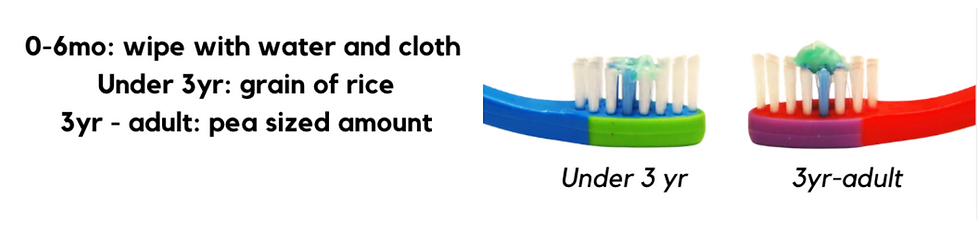
With properly used fluoride toothpaste (meaning parent-assisted brushing, tiny amounts, supervised use, and spitting instead of swallowing) systemic exposure is dramatically lower. Not saying there's no risk, but it is nowhere near an equal comparison.
Cavities Are About More Than Toothpaste
At the same time, I don’t think any toothpaste should be viewed as some magical cure-all either, because oral health is about so much more than toothpaste. Honestly, mostly more than toothpaste.
There are people who use prescription fluoride toothpaste, fluoride rinses, fluoride varnishes, fluoride coated floss, and still struggle with cavities and demineralization. And then there are people who use no fluoride whatsoever and never get cavities at all.

I mean, just look at the tribes Weston A. Price studied. No toothpaste, and hardly any oral decay…until they were westernized.
Why? Because cavities are multifactorial, and NOT about toothpaste.
Root Cause Matters
Saliva quality matters. Mouth breathing matters. Airway health matters. Diet matters. Feeding habits matter. Microbiome balance matters. Sleep matters. Bacterial load matters. Overall systemic health matters.
Toothpaste can only do so much.
That’s also why I think focusing exclusively on the “perfect” ingredient misses the bigger picture entirely. More important than obsessing over fluoride versus hydroxyapatite is addressing why someone is cavity-prone in the first place.
What does their nutrition look like?
Are they constantly snacking?
Are they mouth breathing?
Do they snore?
Do they have poor saliva flow?
Do they have airway issues?
Do they have high pathogenic bacterial loads?
And WHY?????
These are the questions that matter long term. Root cause, people!!! BUT…that doesn’t mean toothpaste is useless, either - especially in today's society.
Toothpaste is still a tool. And sometimes, especially in higher-risk situations, the right tool can provide an important extra layer of protection while you work on addressing those deeper root causes.
It Shouldn't be One Side vs. the Other
I think this is where both the conventional and crunchy worlds sometimes lose sight. Fluoride was never intended to “fix” every cavity on its own. And hydroxyapatite was never meant to be marketed as a universal replacement for fluoride in every patient regardless of risk level.
It should never be about “picking a side.” It should be about understanding individual risk factors, looking at the whole patient, and using tools responsibly and appropriately.
For some people, hydroxyapatite may be more than enough. For others (especially high-risk individuals with deep, active demineralization) fluoride may still provide an important additional layer of protection while the deeper root causes are being addressed.
This is where I currently stand.
My Final Thoughts
I still love and use hydroxyapatite, and I still believe remineralization is possible (like I said, I've experienced it first hand). But I also think fluoride toothpaste has been overly demonized online without enough nuance, context, or understanding of actual dose and risk.
I also think it can be misleading when people online broadly tell everyone to switch from fluoride to hydroxyapatite without understanding that person’s cavity risk, airway health, saliva flow, bacterial load, diet, oral habits, or overall situation. Only a person's trusted biological, airway dentist can truly offer that guidance. Not every mouth has the same risk factors, and prevention should never be one-size-fits-all.
And I'll be the first to admit, I have been guilty of this. But you live, you learn, you accept when you were wrong, and you become better from it!
All in all, in my son’s specific situation, I’m choosing the approach that I personally feel offers the best protection right now, while still focusing heavily on overall airway and oral health as a whole.

Comments